Thank you for agreeing to review submissions for RSECon26. Your participation in this process is vital to ensuring that the programme of the conference is of high quality and that the conference is a success.
The programme team has prepared this reviewer guidance to clarify what is expected of reviewers and to make the review criteria as clear and easy as possible to apply, ensuring consistency between reviews. Should you have any questions during your review, please contact us at [email protected].
Before Starting Your Reviews
- Familiarise yourself with the conference vision statement. You will need to ensure that your evaluation aligns well with the conference focus area.
- Read the submission guidelines and review criteria.
During Your Reviews
- Confidentiality and integrity: Treat all submissions as confidential documents and refrain from sharing or discussing them with others. You should conduct your evaluation objectively, impartially and avoid any bias.
- Abstention: If there are any reviews you have been assigned but wish to decline due to, for example, a conflict of interest, or not feeling able to assess the technical aspect of the submission, please contact the programme team at [email protected], and we will reassign the submission to another reviewer.
- Feedback: Provide respectful, constructive and specific feedback to submitters. Offer detailed and constructive feedback to authors, focusing on strengths and weaknesses and areas of improvement. Providing specific suggestions or examples that support your comments will greatly help the authors in making their contribution stronger. Regardless of the comments and/or criticisms you may have, feedback should always be professional and respectful.
- Timeline: We kindly ask that you adhere to the timeline and deadlines provided by the conference committee and ensure that your reviews are submitted on time. This will greatly help us in the organisation of the timeline. Should you be unable to meet the deadlines, please contact us as soon as possible.
If you have any questions during your reviews regarding the submissions of the review process, do not hesitate to seek clarification or assistance. You can contact the programme team at [email protected].
Each submission will have a minimum of two reviewers. The grades and feedback from each reviewer will inform the final acceptance of the contribution. We fully expect to see divergence between reviewers; constructive feedback from all members of the community is valid, welcome and encouraged. The final decision of which submissions are accepted rests with the programme team.
Notes on Bias and Inclusivity
The conference committee is committed to creating a welcoming and diverse environment for the conference. We ask that you be mindful of common undesirable biases when making your decisions. The first line of defence is awareness [Nature 526, 163 (2015)]. We ask that you review the definitions of relevant common forms of bias so that they are at the forefront of your mind as you read submissions.
Common forms of bias to watch out for:
- Affinity bias — favouring those with similar backgrounds, interests or beliefs.
- Confirmation bias — favouring information consistent with your own existing beliefs.
- Affect heuristics — relying on emotions, over objective information, to perform evaluation.
Bear in mind that submissions may come from people for whom English is not their native language, or text is not their preferred method of communication. Ultimately, the sessions will be presented live, so text will not be the final format. Where the intent of the text is clear, please disregard any errors of spelling and grammar from your considerations, though constructive feedback is welcome, as speakers will have an opportunity to amend their abstracts prior to the conference.
How to Conduct a Review
The Review Form
When starting a review, you will be asked to answer questions in a form on the Oxford Abstracts system. There will be a form for each submission you have to review. Most of these questions will require you to give a grade from 1 to 5, where 1 corresponds to strong negative, 3 corresponds to neutral or uncertain and 5 a strong positive, as displayed in the image below.
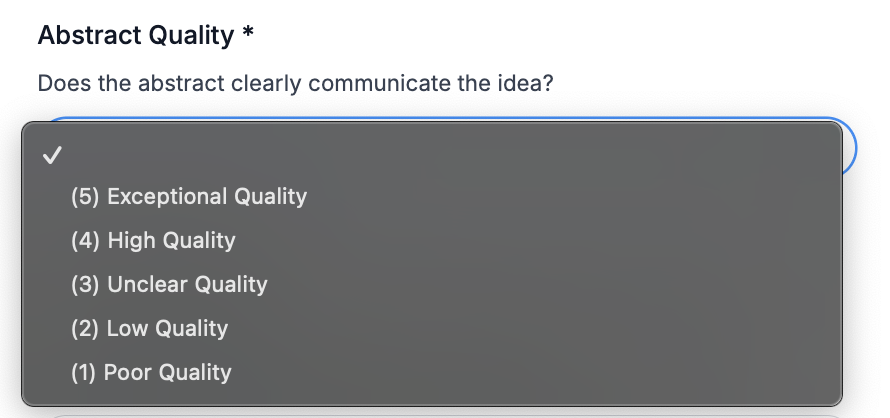
Here is the list of questions that you will need to answer:
-
Conflict of interest (checkbox)
- Relevance to audience (grade 1-5)
- Is the topic of interest to the RSE community > Is this a novel topic?
- Abstract quality (grade 1-5)
- Does the abstract clearly communicate the idea?
- Internal consistency (grade 1-5)
- Do all components of the submission align (e.g. are prerequisites and outcomes appropriate)?
- Is the length of the proposed session appropriate?
- Does this talk have clear goals to upskill or motivate the audience?
- Technical level (multiple choices)
- What is the technical level of this talk?
- Audience size (choice)
- As we have rooms of different sizes, we ask you, based on your knowledge, to estimate how popular you think this submission will be (this is not a measure of quality; we expect high-quality niche and general-interest talks).
- Conference theme (choice)
- You will be asked to indicate which theme(s) the proposed submission aligns with. You can select both themes.
- Viability (choice) — This threshold is easy to meet for most talks and posters, but be careful when reviewing interactive sessions such as workshops and Birds of a Feather. Consider:
- How will they deliver the submission?
- How will they support attendees both in-person and online?
- The number of attendees they could reasonably deliver the workshop to, bearing in mind both in-person and online attendees.
- What software and tooling will they be providing access to?
- What attendees will need to install in advance or bring along (e.g. a piece of their own code)?
Your Final Decision
Similar to the grades that you provide for the review criteria, you are asked to provide a final grade as to whether you would accept or reject a submission. This is again a graded question where you select a decision ranging from a strong reject to a strong accept.
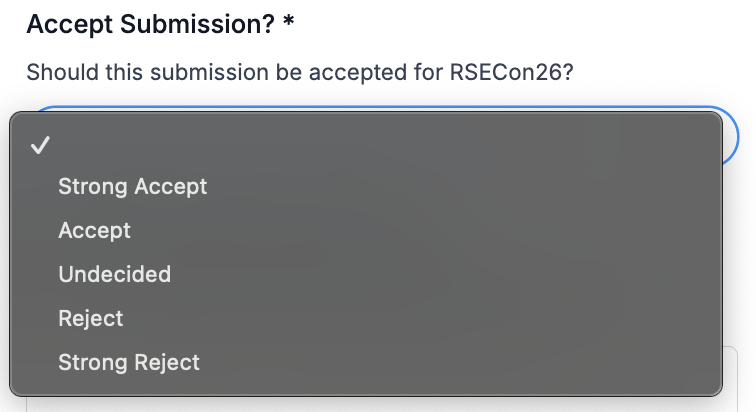
Strong Accept: This is judged to be a high-quality contribution which will add value either via seeding discussion or presenting a complete and high-quality piece of work. It is well-suited to the audience of the conference.
Strong Reject: This submission does not fit well with the audience of the conference, it has not been well thought out, and/or it will not add significantly to existing or previous discussions on the same topic.
Feedback
We ask that you write a sentence or two of constructive feedback to the author of the submission, and a sentence of justification to the programme team (which will not be shared with the submitter).
All constructive feedback will be moderated by the programme team, prior to returning it to submitters, to ensure that comments are respectful.
If you are finding it difficult to write constructive feedback, consider highlighting a strength (what you like about the submission) and a weakness (how you would improve the submission).
It is expected that a submission with positive grades for review criteria would also receive an acceptance grade. If you have reason to diverge from this, your reasoning should be clear in your justification to the programme team.
There will be many good submissions, so, likely, the programme team will ultimately have to reject some abstracts which receive positive feedback. Therefore, the strength of the justification that you provide may impact the likelihood of a submission’s selection.